Last updated on March 21st, 2023 at 12:59 am
How Do You Know If You’re Using The Right Needle?
By Sarah J Doyle
As we get caught up in trying to get sewing projects completed and move on to the next one in the limited time available it is so very easy just to jump from project to project without giving any thought to whether or not we have the right needle in the sewing machine.
It can be a costly mistake to simply use the same needle for everything you sew until it breaks.
The size of the needle you use depends upon the size of the fabric yarns in the fabric. The finer the yarns, the finer the needle needs to be. In general, a needle should be fine enough to penetrate the fabric without marring it, yet have a large enough eye that the thread does not fray or break during the sewing process.
AllFreeCrafts is reader supported! Many supplies are found at thrift stores so try that first! However, if you buy from an affiliate link on this site, I earn a commission at no extra cost to you. As an Amazon associate, I earn from qualifying purchases. This has kept AllFreeCrafts.com online since 2002. Thank you!
Sharp Point, Ball Point, and Wedge Point Sewing Needles
Needle types related to fabric structure are sharp point (regular) for woven fabrics, ball point for knits, and wedge point for leather and vinyl.
Sharp Point Sewing Machine Needles
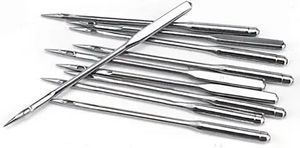
The REGULAR SHARP POINT NEEDLE is ideal for all woven fabrics because it helps to produce an even stitch and causes a minimum of fabric puckering.
This needle is not recommended for knits, as it has a tendency to “cut” yarns and cause skipped stitches.
Regular sharp point needles come in a wide range of sizes from the finest size 9 to a heavy size 18.
Ball Point Sewing Machine Needles

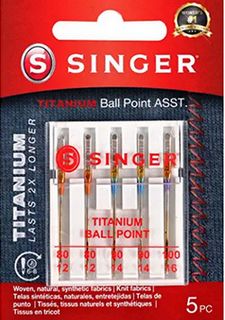
The BALL POINT NEEDLE is specifically designed for knit and elastic fabrics and has a “rounded” point rather than a sharp point.
This needle pushes between the fabric yarns rather than “cutting through” the yarns.
This needle comes in sizes 9 to 16 and the larger the needle size, the more “rounded” the needle point is.
Wedge Point Sewing Machine Needles
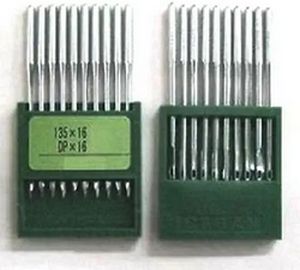
The WEDGE POINT NEEDLE, which is designed for leather and vinyl, easily pierces these fabrics to make a hole that will close back upon itself.
This eliminates unattractive holes in the garment, and also reduces the risk of the stitches tearing the fabric.
The wedge point needle comes in sizes 11 to 18. The size 11 needle is designed for soft pliable leathers,while size 18 is designed for heavy or multiple layers of leather or vinyl.
How to Choose the Proper Needle Size for Your Sewing Project
In addition to choosing the right TYPE of needle, it is also important to know the proper needle SIZE for the type of fabric being used. As a general rule you can utilize the following fabric category/needle size information when choosing the needle for your next project.
DELICATE fabrics such as silk, chiffon, voile, fine lace and organdy would need a fine “size 9” needle.
LIGHTWEIGHT fabrics such as synthetic sheers, batiste, taffeta, velvet, stretch fabric, tricot and plastic film would need a “size 11” needle.
MEDIUM WEIGHT fabrics such as gingham, poplin, linen, muslin, chambray, wool crepe, flannel, knits, jersey, wool, chintz, satin, raw silk, wool suiting, stretch fabric and drapery fabrics would need a “size 14” needle.
MEDIUM-HEAVY fabrics such as sail cloth, gabardine, heavy suiting, tweed and heavy drapery fabrics would need a “size 16” needle.
HEAVY fabrics such as denim, overcoatings, ticking, upholstery and canvas fabrics would need a “size 18” needle.
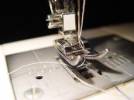
One final needle pointer is always replace dull, bent or nicked needles. If you hit a pin then you should immediately change the needle. A bent needle, even if only “slightly” bent or nicked can cause skipped stitches and can easily cause damage to your fabric by tearing the fabric yarns.
Ideally, use a new needle for each sewing project and change it frequently, especially if you are experiencing skipped stitches or breaking threads. By selecting the right sewing machine needle, you’ll be able to achieve a professional-looking sewing project.
For part one of this series on basic sewing, see Choosing the Right Sewing Thread
About the author: Sarah J. Doyle is author of over 25 sewing, craft and how-to books, as well as author of online pattern making, sewing and craft classes. Visit LearnHowtoSew.com for more tips and how-to information on sewing and crafting.
Copyright 2004-2023 Sarah J. Doyle. All Rights Reserved.

Marilyn Mouton says
Great website, thank you. you get exactly what you ask for. Well don