Last updated on September 27th, 2015 at 02:11 am
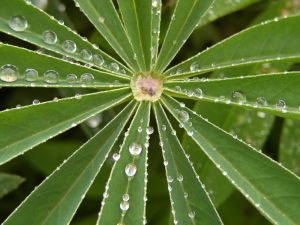
Lupin Leaf Repelling Water Droplets
Watering Your Garden – How to Make Each Drop Count
by Yvonne Cunnington
Water-wise gardening or xeriscaping – the practice of gardening in dry conditions – is becoming much more important to gardeners, especially those in dry areas.
If you have sandy soil, steep slopes where water runs off quickly, a country garden you visit only on weekends, high water bills or watering restrictions during the growing season, read on to find out how to save money, use water resources more responsibly and stop lugging all those hoses around unnecessarily.
Ten ways to make each drop count:
Group especially thirsty plants together, so you can water them without having to do the entire garden; take advantage of low moist spots for such plants.
Investigate drought-tolerant plants – they often have taproots, or grey, fuzzy, waxy or finely divided leaves.
Avoid frequent, shallow waterings; water needs to penetrate about four inches into soil for it to do any good.
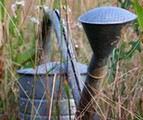 Encourage plants to develop extensive root systems by infrequent, but deep, generous watering – about one inch of water every week if rainfall is inadequate (buy a rain gauge to measure precipitation, so you don’t water unnecessarily).
Mulch bare soil to a depth of two to four inches to prevent evaporation and maintain soil moisture; use organic materials such as shredded wood or bark, straw, shredded leaves, compost or cocoa bean hulls; (inorganic mulch such as gravel or stone chips also retains moisture, but won’t break down to help improve soil).
Don’t water between 10 a.m. and 6 p.m. when hot sun evaporates a lot of water.
Water plants at soil level to get moisture straight to roots, rather than on leaves.
Use soaker hoses or drip irrigation, rather than sprinklers (much of the water thrown into the air by sprinklers evaporates); these systems also avoid wasting water on walkways, patios and driveways.
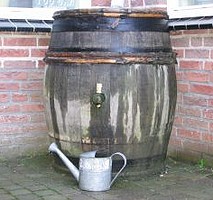
Install a barrel to collect rainwater from roof; a modest rain of one quarter of an inch on a 1000 ft square roof yields 150 gallons; rain barrels come with a shut-off valve and hose connection so you can fill your watering can for hand-watering.
During drought, water large trees by allowing your hose to dribble a small amount of water around the drip-line for several hours to ensure that water is absorbed instead running off quickly. Newly planted trees need supplemental water for the first two seasons, especially in hot, dry summers.
Garden writer Yvonne Cunnington dispenses gardening tips at her website: flower-gardening-made-easy.com.
 Recycling Water for Your Garden
by Karsten Madsen
Recycling water is something I’m quite sure that most gardeners and allotmenteers do anyway – but for those of you who don’t – there’s help to get from this article. If you’re already recycling water in your garden or on your allotment plot – keep reading though! You may still learn something.
The obvious thing to do – when recycling water – is to collect rainwater from the roof of your house, shed(s) and greenhouse(s). If you haven’t got a gutter fitted already – or if you are not diverting water from an existing gutter – it’s not a big job to do. In the long run it will save you a lot of time – and money if you pay for your water as per usage – not having to fill your water butts from the mains supply.
Roof Water
If you have a large area under roof – you may consider linking up a number of water butts. You can easily do this by connecting the overflow from your first water butt to the bottom of the next one, using a piece of hose pipe. Gravity will do the rest.
Grey Water
Another way of recycling water is to use the much underused resource of grey water. Grey water is defined as water, previously used in the home, for washing and bathing. It’s easy to reuse this water in your garden or on your allotment plot, as long as you adhere to a few simple rules:
- Never re-use water containing strong chemicals or detergents (ie from a dishwasher), as it’s too contaminated. Water from baths and showers is fine.
- Always allow the water to go cold before re-using it
- Use grey water in different places in your garden or on your plot.
- Never use grey water on edible crops or leaves
I know the above rules may rule out the use of grey water for a lot of allotmenteers – but for those of you who grow cut flowers etc. – limited use shoud be fine, and the re-use of grey water applies to those of you who has a garden of your own as well as an allotment plot.
Karsten Madsen is the webmaster of https://www.allotmenteer.co.uk.
Leave a Reply