Last updated on December 31st, 2023 at 11:44 pm
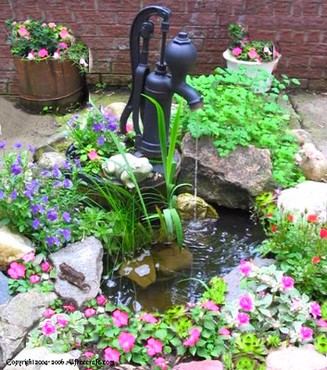
How to Make an Outdoor Water Fountain or Water Garden
by Debbie Rodgers
When hot, sticky days hit, try to use all your senses to keep cool. Sight and sound have amazing psychological effects, even when the thermometer soars.
One of the most cooling and relaxing sounds I know is that of a trickling spring. It relaxes my mind and helps my body unwind. In the city, it can drown out the sounds of the daily hustle and bustle of life, calming and refreshing the spirit. I also love the glinting, reflective surface of water. You can have the soothing coolness of water without a huge space so why not recreate this in your outdoor living area?
Some small water features have still water and aquatic plants but with the fight to remove stagnant water where mosquitoes can breed, many people now prefer items with moving water.
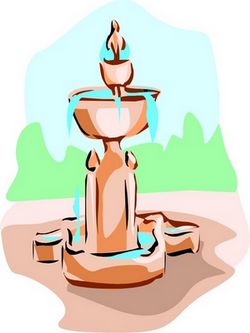
The most popular “moving water” items are tabletop fountains, statuary fountains and spitting creatures. All rely on a pump to circulate water through the feature. The water is pumped up through plastic tubing and released into the fountain, returning to the bottom where it is pumped up the tubing again. Most pumps run on an electrical connection but some smaller tabletop fountains have batteries. There are also solar units available that require no
electrical hook-up.
What You Will Need:
If you are going to make a water fountain feature, you need the following elements:
- a “bottom” where the pump where will be located and the water returns. This can be a large pot, an urn, a trough and so on.
- a “top” from which the water will emerge. This can be a small pot, a fanciful creature such as a frog, a conch shell, etc.
- a “middle” – the water course which will receive the water from the top and return it to the bottom. This can be pots, pebbles, shells, marbles, or even empty space, creating a freefall.
- a pump
Maximum Gallons per Hour and Maximum Lift
Give crucial attention to two features of the pump: maximum gallons per hour (gph) and maximum lift.
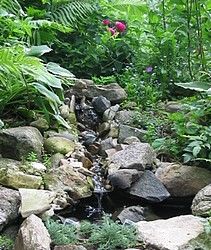
The gph can vary from 35 gph for a small battery-operated tabletop unit to over 600 gph for large garden fountains. Choose one appropriate to the size of your water feature – more is not necessarily better. A low gph will give you a gurgling effect in the same fountain that a higher gph pump would provide a steady stream – or even splash. It’s strictly a personal preference within the range recommended for the fountain size.
The maximum lift figure tells you how high you can expect your “little pump that could” to push the water. A small pump that has a lift of “up to 2 feet”, for example would not be appropriate for your 3-foot wall mounted lion’s head.
You will also want to consider the length of the electrical cord if applicable, and whether the unit has an on/off switch, if that’s important to you. Remember, though, that water left sitting will stagnate.
Pump kits are available that include pump and tubing but tubing is quite inexpensive and can be purchased at most garden centers. You can make a water fountain from something as simple as terracotta pots and pebbles.
So soothe your senses with the calming sounds of moving water and keep cool in your outdoor space!




Leave a Reply